


I originally wrote this essay for the Account Planning Group of Canada.

For the past several months, I’ve been designing a strategy board game called Cola Wars. In Cola Wars, you play as a 1980s marketing executive for a start-up cola brand competing against the evil CorpoCola (tagline: “Enjoy… or else.”) You build your brand by increasing your mental share and shelf share.
Yes, it’s basically “How Brands Grow: The Board Game.” I’m a nerd.
Anyway, the process of designing Cola Wars has involved a lot of reflection on the intersection between tabletop gaming and marketing, especially with respect to randomness.
There are many different ways to classify board games, but one of the most important — and hotly debated — dimensions is how much luck is involved in playing them.
Some games have very little luck at all. In chess, the only role luck plays – in theory – is in deciding who plays white. Snakes and ladders, on the other hand, is all luck. There is no strategy involved at all; you are completely at the mercy of the dice.
Most board games exist somewhere in the middle. There are winning strategies for Monopoly (although really only a few good ones) but also a great deal of luck (the dice and the chance and community chest cards and also whether you get to play as the best piece, the top hat.) The winner of a game of Monopoly might have had the best strategy or the most luck, but usually it will be a mix of both.
Modern board games are often said to belong to one of two categories, and while luck is not the only dimension that separates them, it is one of the primary ones.
Eurogames either involve very little luck or involve luck but before you make a move. For example, a roll of the dice or a draw of cards might give you a sheaf of wheat or a pig. But when you use that wheat or that pig, the results will be completely predictable. You can always turn two wheats into a pig, or two pigs into three bricks, or six bricks into a victory point, or who knows what. (Eurogames often seem to be about the lives of medieval peasants.) Some examples of Eurogames include Agricola, Carcassonne, or Ticket to Ride.
“Ameritrash” board games — the hobby insists that the term is not meant to be derogatory — generally have more conflict between the players than eurogames and a lot more luck. In an Ameritrash game, you might choose an action and then roll the dice to see if you are successful. Examples of Ameritrash games include Axis and Allies, Twilight Imperium, (arguably) Risk, or (arguably) Monopoly.
Put simply: Eurogames are about managing resources, and Ameritrash games are about managing risk.
Among the most “serious” board gamers, too much luck is considered a bad thing. Many gamers would prefer to have no luck at all and treat every game purely as a battle of wits. Others enjoy games with a lot of luck; there would be no Las Vegas if human beings didn’t enjoy the thrill of luck-based games, after all.
Board games and marketing have a great deal in common. Gamers and marketers alike use war metaphors; they both employ strategy; they both seek to “win” against competitors. But I can think of surprisingly few board games themed around marketing.
One of the few prominent examples of a marketing-themed board game is Food Chain Magnate. Food Chain Magnate is famous for being exceedingly complex and also completely devoid of luck. Here’s a telling quote from Reddit about Food Chain Magnate: “It is a Euro Game in [the same way that] a Monster Truck is technically a truck.”
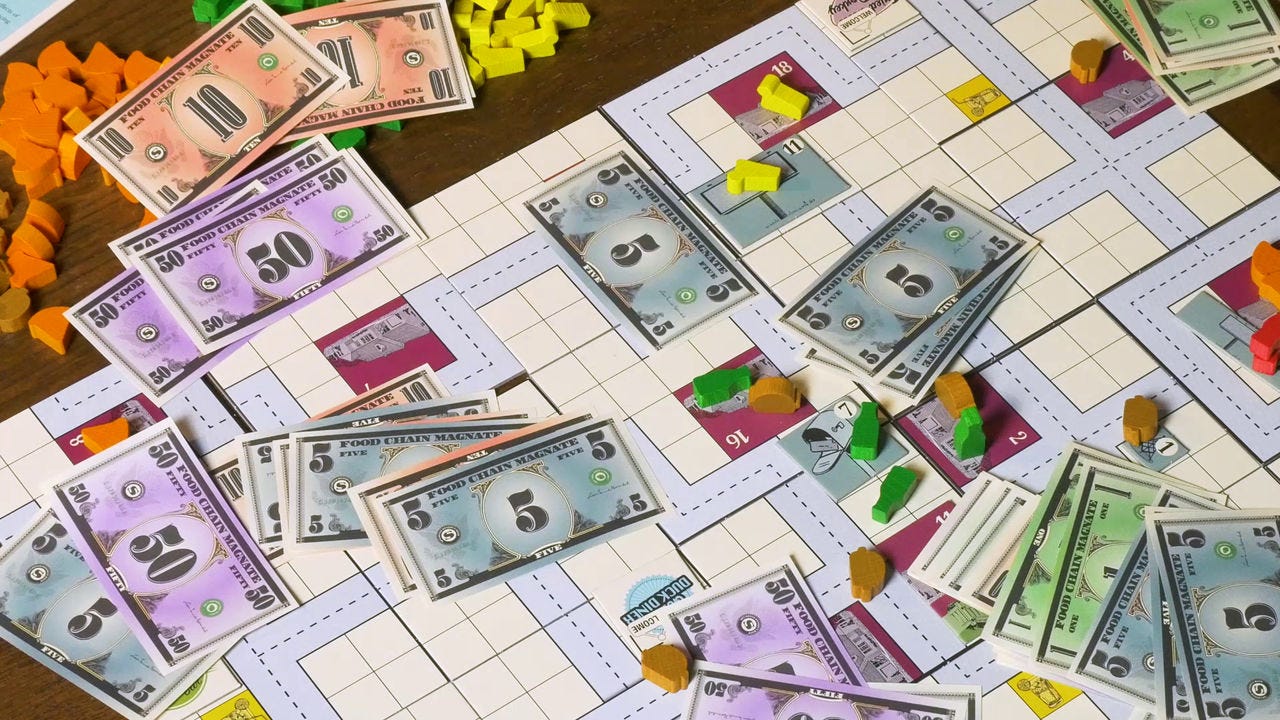
You might place a billboard in a neighbourhood, and if there is a house in range of that advertising, they will buy your hamburger. Otherwise, they won’t. The game is entirely deterministic. The only variable is the choices the players make (and there are a lot of choices to be made.)
I enjoyed Food Chain Magnate the one time I played it, and I even spent way too much money to back the fancy reprint on crowdfunding. (No, seriously, an embarrassing amount.)
But Food Chain Magnate is nothing like marketing. Because marketing isn’t a Eurogame. It’s pure, unadulterated Ameritrash.
Roger Martin — the former dean of Rotman — distinguishes between “strategy” and “planning.” (He’s using those terms in a business sense, not an agency sense. I’m going to paraphrase him and, hopefully, not fully mangle his intentions.)
Planning is about what you can control. You can control timelines. You can control how your organization is structured. Most of all, you can control costs, usually. On these dimensions, the outcomes can be fairly predictable. Planning is a Eurogame.
Strategy is about influencing things you can’t fully control. Strategy involves making informed choices based on a theory of how you can win. You might have a theory that if you do X, then Y is more likely to result. But you can’t control what competitors do, or what consumers do, or the weather, or the stock market, or any number of a million factors beyond your control. Strategy is Ameritrash.
Planning is comfortable and safe. It tends to be what’s taught in business schools. Measure everything, control everything, and then you can make your numbers go up or down. It’s usually easy to do this by cutting costs.
But strategy, for all its unpredictability, is how real growth happens. Strategy acknowledges the importance of measurement and the need to control what you can control — but it also acknowledges that the things that matter most to your success are outside of your control. Sometimes even the “right” strategy, based on the best information available to you and flawlessly executed, can fail.
Because in real life, unlike in Food Chain Magnate, the cards are never all face up.
Many people, especially those in digital media, promise a vision of advertising that planners can love. Through the miracle of targeting, predictive analytics, or insert-buzzword-here, businesses can reach the right people at the right time and earn a guaranteed conversion.
Often these solutions offer what planners really need — numbers — without offering much in the way of what they’re supposed to be after, growth. A search ad may indeed offer an impressive conversion rate, but if it’s only “catching people as they fall” (that is, attracting buyers who were close to buying anyway) then its impact is going to be limited.
In Cola Wars, you set your strategy and there are many ways to tilt the odds in your favour, but it’s the consumer — represented by a set of ten dice — that has the last word on whether you succeed or fail.
In the playtests I’ve run for Cola Wars, some people don’t like this. After all, with this system, some people win who didn’t “deserve” to win. And some people with smart strategies lose out to an unlucky roll. Several playtesters have suggested that I move the dice rolls so that they happen first, and players can react to them already knowing the outcome.
If you work in advertising, you’ve probably heard something similar from your clients.
But the truth is, if we’re going to be effective in marketing, we have to be comfortable with the fact that much lies outside of our control. We can influence the most important factors driving success, but we can’t dictate them, and we rarely have the luxury of reacting to complete information.
Eurogames are fun. They’re also a fantasy.