

Finishing the Hat
Mixed feelings about tabletop prototypes in the age of generative AI, and a (possibly?) funny story

I would not publish a game under Fleming & Hound that uses AI-generated art. I want to get that out of the way because it’s a very emotional subject, and I get it.
Like many people in creative fields, I feel deeply ambivalent about generative AI.
On the one hand, society is only beginning to come to terms with how disruptive AI is likely to be to our economy, culture, and politics. The science fiction writer Ted Chiang has said that fears about AI are really fears about capitalism;1 if that’s true, then there’s a lot for us to fear.
Add to that the legitimate concerns about how these models are trained. It’s not clear to me that generative AI is a form of theft or plagiarism; it’s more complicated than that. But there’s no question that a lot of the tactics used to train the LLMs have been underhanded at best.
On the other hand… it’s hard to deny what an amazing tool AI can be. That almost scares me more.
Limelight and AI
If it should ever be published, Limelight will not use AI-generated artwork. But I have used ChatGPT in two ways to produce the prototype:
Generating names for cast members. Representation is important to me. I like the idea that gamers will see themselves represented in the games I design and that it will mean something to them. But like everyone, I have blindspots. So I used ChatGPT to randomly generate names for characters in the game to ensure adequate diversity and also to try to avoid stereotypes.
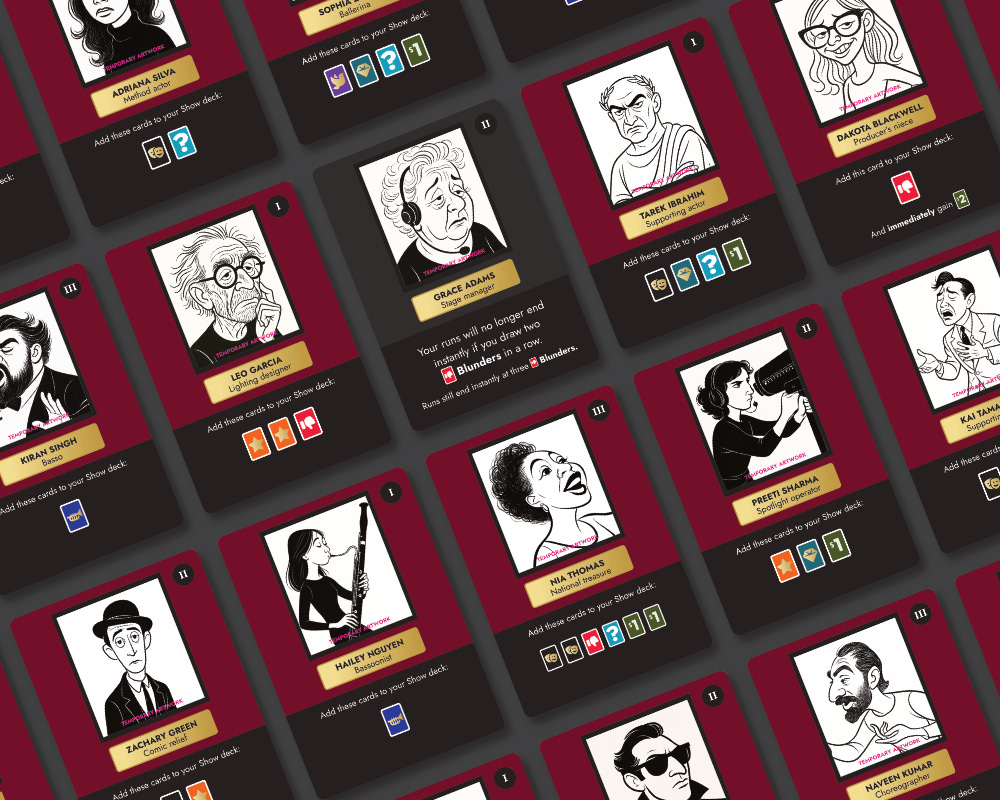
Generating temporary placeholder art for cards. The traditional way to get art for a prototype board game is to literally steal it — find an image online, swipe it, replace the image later in development. It seems to me using generative AI is at least better than that. The placeholder art is identified as being temporary and I disclose that it is AI-generated at the start of every playtest.
So I’ve made my peace with using AI in prototyping. Sort of. More or less. I’m sleeping at least 15 minutes a night, and only spending a couple hours a day worrying about the robot apocalypse.
And if I’m being totally honest, I had a blast last weekend using ChatGPT’s 4o model to generate 85 portraits for the characters in the game.
Since I first had the idea for Limelight, it has been my intention that each cast or crew member in the game should be represented by a theatrical caricature, as though they all have portraits on the wall at Sardi’s. I wanted to demonstrate that ambition in the prototype.2
Here are two things I discovered generating the temporary artwork for Limelight:
AI is getting pretty damn good.
In ChatGPT 4o, the people have the right number of fingers. In the hundred or so images it produced for me, I think perhaps two featured musicians with three arms, and getting the followspot operator right was a bit of a challenge. But for the most part, not bad.
Actually… better than not bad.
This art could absolutely be better. It feels generic with no particularly distinctive style or voice. ChatGPT is definitely no Al Hirschfeld. If Limelight becomes a viable product, I will want the art to be better: more expressive, more unique. But if I’m being totally honest… these images are pretty close to being “good enough.”
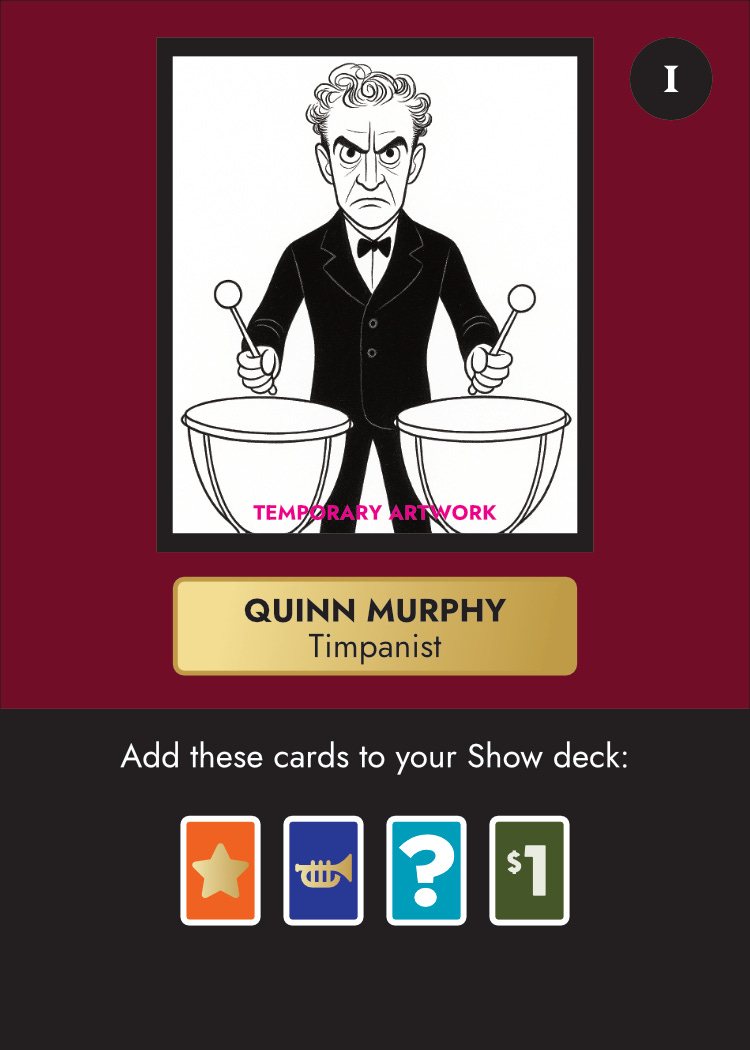
For example, this image made me crack up when I saw it. I love this guy’s expression, like he’s been waiting his whole entire life to go aggro on a set of drums, and his moment is just about to come.
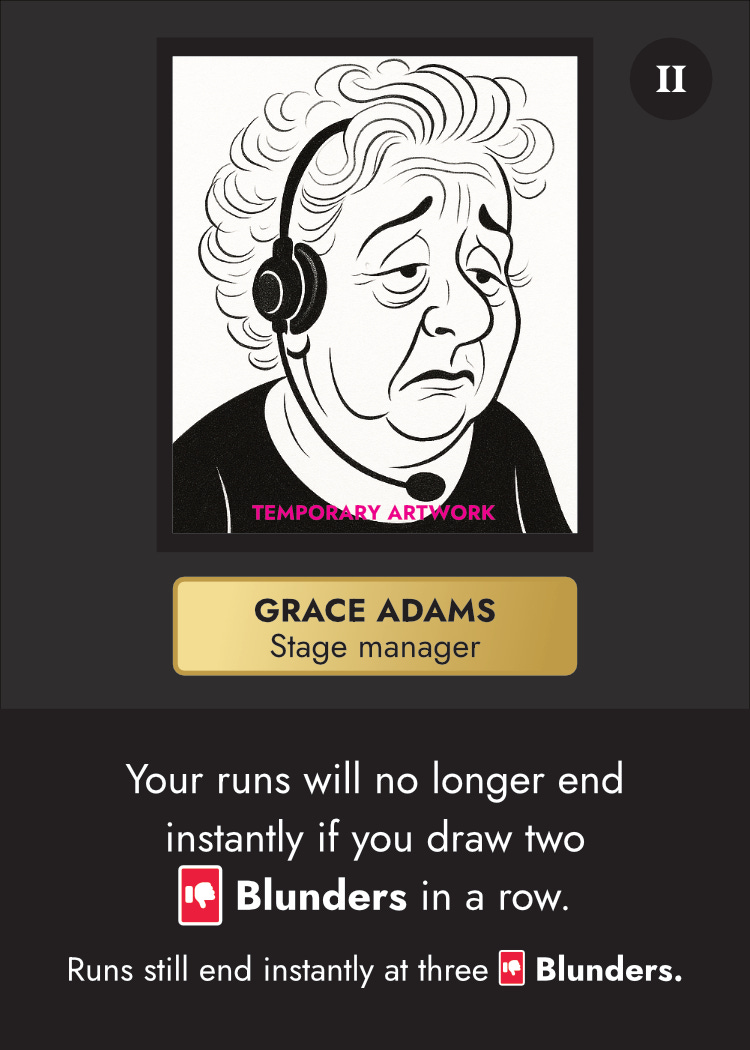
And then there’s this one of a world-weary stage manager.
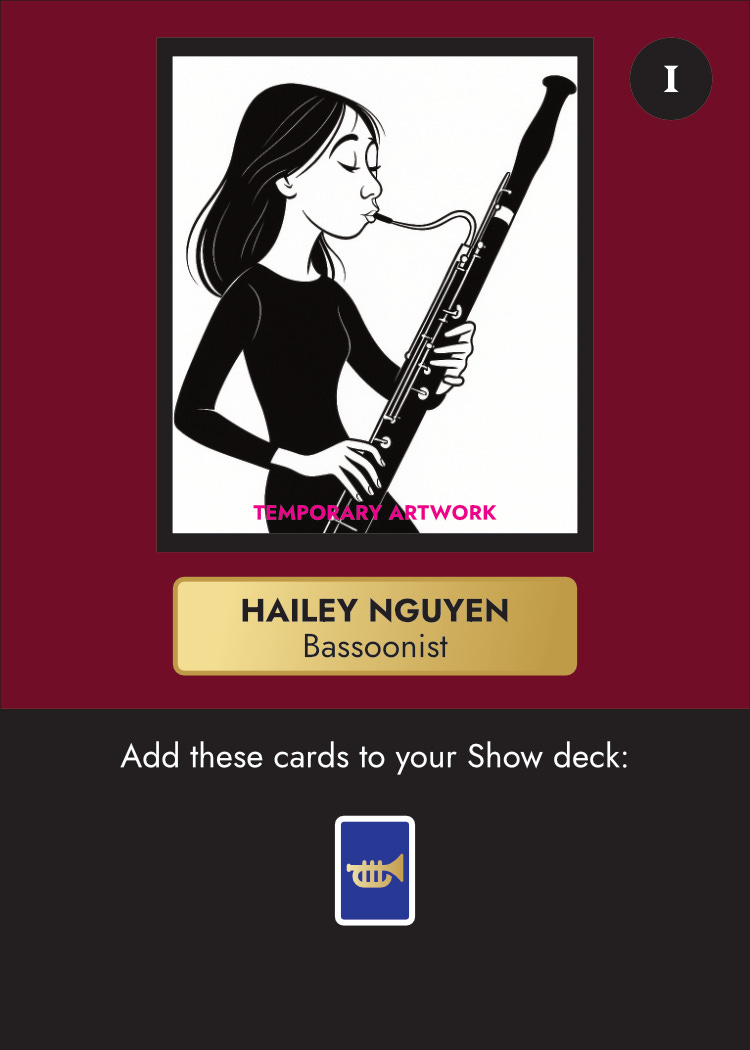
And this one, of a bassoonist, isn’t funny but I like that it does have at least a hint of Hirschfeld’s expressive lines.3 Also, I have no idea how to play the bassoon but to my very inexpert eyes her fingering looks at least plausible.
On the other hand…
AI is still pretty weird.
ChatGPT is the world’s friendliest black box. But the inner workings can be a little weird.
Our “creative collaboration” was humming along when, about 65 characters in, I came to a card depicting a pop star making her Boardway debut. I didn’t really have the words to prompt this properly. I’m just not “hip” or “with it” enough, as the kids say. So this is when I made my fatal mistake:
I suggested that the character could have a “Taylor Swift vibe.” I didn’t want a character who looked like Taylor Swift, or any pop star, for that matter. Just someone with a “Taylor Swift vibe.” Whatever that means.
And ChatGPT flipped out.
All of a sudden, I could barely get any prompts through. I would just get a notice that ChatGPT couldn’t generate the image because it would violate their content policy. I would ask why, and ChatGPT wouldn’t really know — because it seems the policy enforcer and the generator are separate processes, each mysterious to the other.
At first it was clear that it just didn’t want me generating images of Taylor Swift. It hadn’t had any trouble with my references to Buster Keaton or Al Hirschfeld, but apparently T. Swift was a bridge too far.
I explicitly wrote in my prompts that I wanted portraits of fictional characters who did not look like real people, but it didn’t matter. The enforcer had begun to suspect that every prompt was an attempt to create an image of Taylor Swift or some other equally litigious person.
An African-American Broadway technical director in his early 50s? No, could be Taylor Swift.
Redraw that dancer with his arms down by his side? No, Taylor Swift also has arms.
It was so strange to be in this ongoing literal conversation with ChatGPT where it would say, “can’t do that,” I would ask why, we would go back and forth a few times, and ChatGPT would essentially end up saying, “yeah, makes sense, I don’t know what to tell you, you’re right.” But what can you do? The black box confronted with another black box.
By the end, the process had become very slow and frustrating. Score one for the humans, I guess.
The part where I confidently predict the future
Just kidding. I got nothing.
Generative AI is going to keep getting better. Probably.
The economics of generative AI make it inevitable. Probably.
Eventually, the board game community will become more accepting of AI. Probably… in fact I think this might already be happening, grudgingly.
Generative AI will kill this industry and many others. Maybe. Or maybe it’ll usher in a new golden age of creativity. Or maybe both. Or maybe neither.
For now, I don’t feel the need to rush the future along. Generative AI gives you an incredible feeling of power and creativity… but also the uncomfortable feeling that every time you’re using it, you might be digging a grave. Possibly your own.
Ted Chiang wrote the short story that the movie Arrival is based on. He is a tremendous author whose short stories will lodge themselves within your brain and your soul. You should probably stop reading about dumb board games and go read one of his stories right now.
My dream is to eventually work with one of the artists who specialize in doing these sorts of caricatures for real Broadway productions (I already have a dream list.) But that will be expensive, and at this stage in the process, with so much subject to change and with the game’s future uncertain, it’s not feasible.
One thing ChatGPT might have over Hirschfeld: it does a little better with people of colour than Hirschfeld sometimes did. I have to admit I was a little nervous about whether classical caricature could be combined with modern diversity in my prompts, but for the most part this didn’t seem to be an issue.